Reggio Learning: Loose Parts
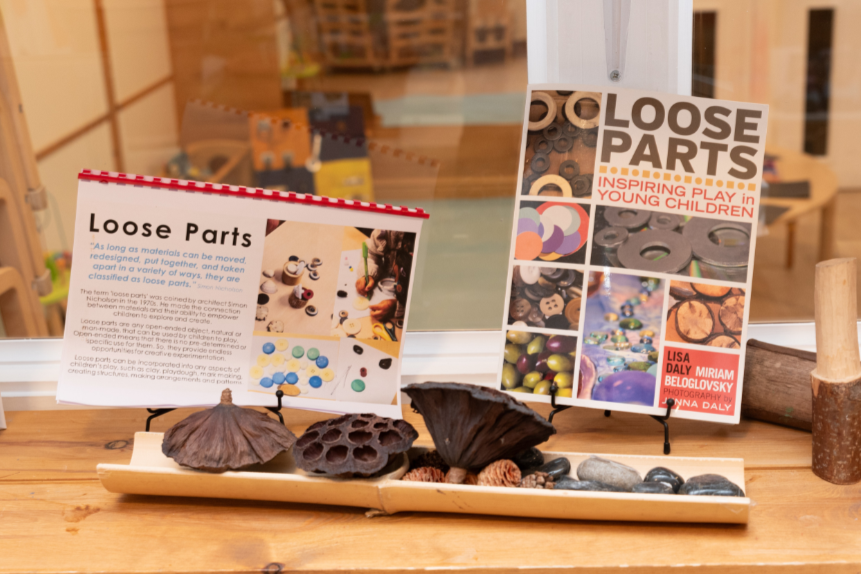
Loose parts play is widely used in early years settings because it supports rich, meaningful exploration. Children learn best when they can follow their interests, create freely and experiment with new ideas at their own pace.
From stones and shells to bottle tops and fabric scraps, loose parts give children the freedom to invent their own worlds, explore possibilities and build strong foundations for early learning.
🌱 What Is Loose Parts Play?
Loose parts are open‑ended materials that children can move, combine, redesign and experiment with during play. Because they have no fixed purpose, children choose how to use them — which sparks imagination and deep thinking.
Common examples include:
natural materials: sticks, stones, pinecones, shells, leaves
everyday household objects: bottle tops, buttons, ribbons, boxes, scraps of fabric
recycled items: tubs, tubes, lids, trays
sensory or art resources: beads, wool, cardboard, corks
A single object might be used in five different ways in one day — and that flexibility is what makes loose parts so powerful.
Loose parts play supports early development in multiple ways. Children experiment, solve problems, collaborate and invent — all through play that feels effortless and joyful.
⭐ Boosts Creativity & Imagination
Loose parts invite children to transform materials into anything they imagine — a magic potion, a campfire, a tower, a shop, a spaceship or a new invention.
⭐ Supports Problem‑Solving & Critical Thinking
Balancing, stacking, sorting and building help children practise reasoning, prediction, trial‑and‑error, and planning.
⭐ Encourages Collaboration & Communication
Loose parts naturally lead to shared play. Children talk, negotiate and work together to create shared ideas or solve challenges.
⭐ Builds Physical & Cognitive Skills
Manipulating different materials strengthens fine motor control, hand‑eye coordination and early STEM concepts such as measurement, comparison, pattern, weight and balance.
The Environment as the “Third Teacher”
In Reggio‑inspired settings, the environment is intentionally designed to encourage exploration and independence. Loose parts are a natural way to support this.
Ideas for Using Loose Parts
Loose parts can be used almost anywhere:
Outdoors
sticks
stones
logs
pinecones
shells
water and sand
Indoors
fabric scraps
buttons
ribbons
cardboard tubes
small boxes
lids and bottle tops
Early STEM
measuring cups
funnels
magnets
wheels and gears
sorting trays
Tip for Parents & Educators
Rotate materials regularly and follow the child’s lead. A small change — a new basket of natural items, colourful lids or different shapes — can inspire entirely new ideas and deeper learning.
⚠️ Safety Note
Please supervise children closely when using small loose parts, as they can pose a choking risk, especially for younger children.